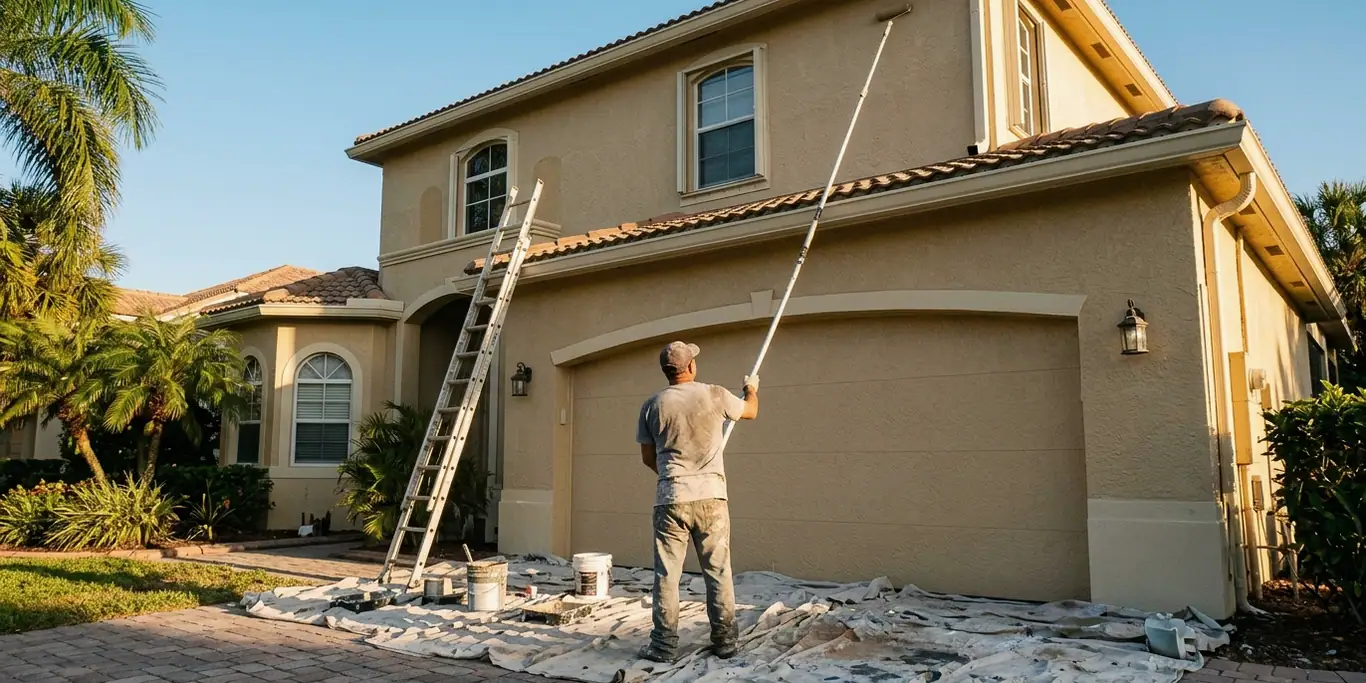
Dry season is the sweet spot
Around Wesley Chapel, the most reliable stretch for exterior painting runs from about October through May. Rain is less frequent, humidity drops, and walls dry out faster after a wash. Most of the year's rain falls in the wet season, roughly June through September, and much of that comes as afternoon thunderstorms.
Within the dry season, late October through December and March through early May are the easiest months. Temperatures are mild, mornings are less soggy, and wind is usually light. January and February are fine most days, but a cold front can bring a few nights in the 40s, which matters for some paints as you will see below.
Painting in summer is possible, with a different schedule
Plenty of houses get painted in July. It just takes a crew that plans around the weather instead of fighting it. In summer, storms often build after lunch and hit somewhere between about 2 and 6 p.m. A fresh coat needs time to set before rain touches it, so summer work moves earlier in the day.
A typical summer day for us looks like this: start washing or prep early, paint the walls that have dried and are out of direct sun, and stop applying finish coats on exposed walls by early afternoon. If the radar shows a cell heading for Pasco, the crew finishes the section it is on, cleans up and covers open areas. Expect a summer project to take a day or two longer than the same job in November.

Morning dew and evening moisture
Dew is the quiet problem nobody talks about. On many mornings, even in the dry season, stucco and trim are wet until 9 or 10 a.m., especially on north and west walls that have not seen sun yet. Paint applied over a damp surface can blister, lose adhesion or show streaks called surfactant leaching, a sticky tan or brown residue that runs down the wall.
The same thing happens in reverse at the end of the day. If a coat goes on at 4 p.m. and dew settles at 7, the film may not have set yet. Good crews follow the sun around the house: east walls in the morning once they dry, west walls in the late morning or early afternoon before they get too hot, and nothing exposed late in the day.
Reading the limits on the paint can
Every exterior paint lists application limits on the label or data sheet. They differ by product, but the usual ones are:
- Minimum temperature, often 35 to 50 degrees for air and surface, for application and for the next several hours.
- Maximum surface temperature, commonly around 90 degrees. A west-facing stucco wall in full sun can run far hotter than the air, which makes paint dry too fast and show lap marks.
- Dew point spread, usually at least 5 degrees between the surface temperature and the dew point.
- Humidity, with some products asking for relative humidity under about 85%.
- Rain-free time, often 1 to 4 hours before the film can take rain, longer in cool or humid weather.
How heat changes the job
Our problem is more often too much heat than too little. Paint on a hot wall flashes, meaning it dries before it can level, which leaves roller marks and thin spots. Elastomeric coatings are especially picky because they go on thick. The fix is simple: paint walls when they are in shade. A crew that works the shady side and moves with the sun will produce a smoother, longer-lasting finish than one that paints every wall at noon.
Darker colors on doors and shutters are also sensitive. A front door facing west can get too hot to touch by midafternoon, so we do those in the morning or take the door off and paint it in the garage.
Hurricane season and booking
Hurricane season runs June 1 to November 30. A named storm in the Gulf can shut down outdoor work for several days even if it never comes near Pasco. If you want your house done before a big family event or a home sale, build in a buffer.
Fall and spring fill up fast because everyone has the same idea. Booking a few weeks ahead for an exterior repaint in October through April is normal. If you are in an HOA community, get your color approval first so it does not hold up the start date. Call (813) 471-5995 for a free on-site look and written estimate. Most single-story stucco repaints in our area land around $3,860 to $6,940, with the final price set after we see the house.