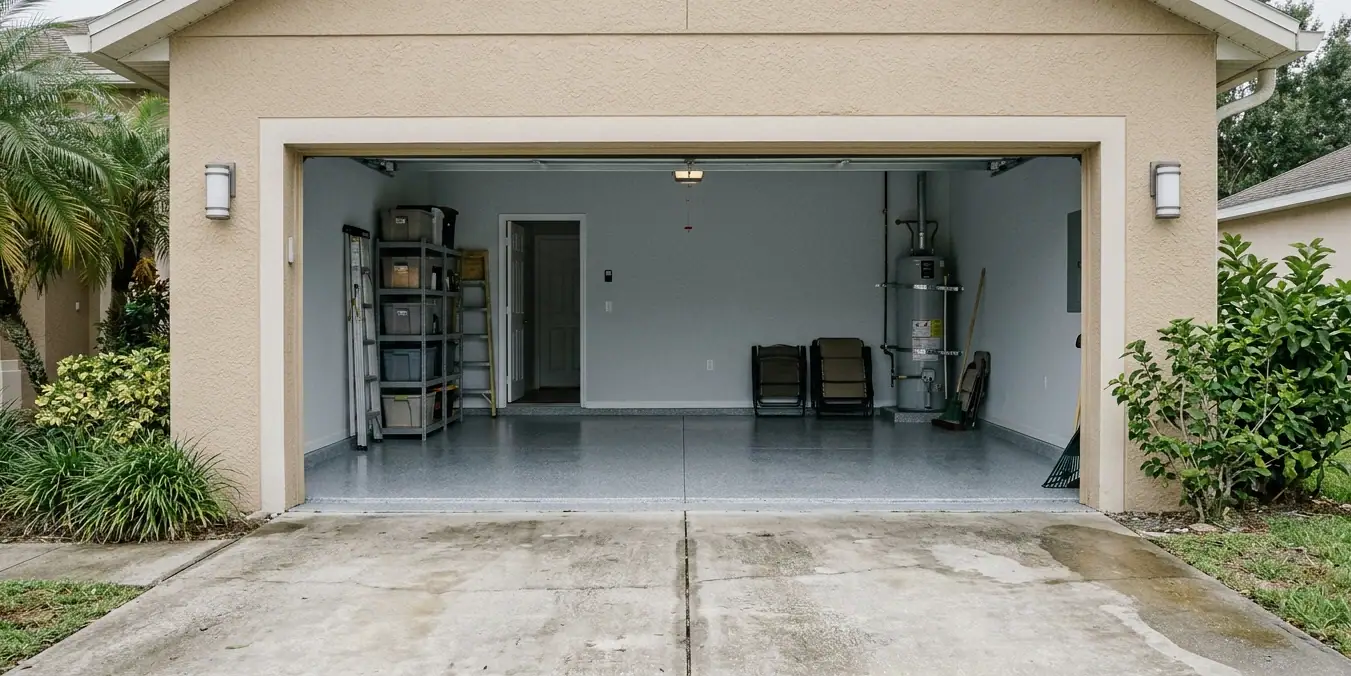
Moisture testing comes first
Florida slabs sit over a high water table, and many garages have either no vapor barrier under the concrete or one that got punctured during the build. Moisture pushing up through the slab is the top reason epoxy floors peel. Before we quote, we test, either with a taped plastic sheet left down for a day or with a meter reading.
If the reading is high, we use a moisture-tolerant base coat made for damp slabs. It costs more, and it is the difference between a floor that lasts and one that lifts in tire-shaped patches within a year.
Grinding, not acid etching
Store kits tell you to etch the floor with acid. That rarely opens the concrete enough. We diamond grind the whole slab with a dust-collecting grinder, which removes the weak top layer, old sealers, paint drips and oil residue and leaves a profile the epoxy can grip. Cracks and spalled spots get filled with a repair compound and ground flush. Control joints can be filled or left open, your call.
The floor system we install
A one-coat home kit goes on a few mils thick. A layered system like this is many times thicker, which is why it handles a car that just came off I-75 on an August afternoon.
- Epoxy base coat, tinted gray, tan or another color, rolled thick enough to bridge small surface flaws.
- Vinyl flake broadcast until the floor is fully covered, which hides dirt and adds texture underfoot.
- Scrape and vacuum of loose flake once the base has cured.
- Polyaspartic or urethane topcoat that resists UV yellowing, hot tires, gasoline and pool chemicals.
What install days look like
Most two-car garages take two days: grinding, repairs, base coat and flake on day one, then scraping and topcoat on day two. The garage has to be emptied, including any shelving bolted to the floor. Foot traffic is fine after about a day, and cars wait 48 to 72 hours. We tape the bottom of the walls and the door seal so the coating stops on a clean line. If the walls are bare or patched, it is a good time for new drywall or paint before the floor goes down.
Call us when you notice
- Oil and tire stains have soaked into the concrete.
- The slab dusts and leaves grit on everything.
- An old DIY coating is peeling under the tires.
- The floor sweats and turns slick on humid mornings.
- You want the garage to work as a gym or shop.
How a garage floor epoxy job runs
Test the slab
We check moisture, old coatings, cracks and oil, then choose the base coat that suits your slab.
Grind and repair
The slab is diamond ground with dust collection, and cracks and pits are filled and ground smooth.
Base coat and flake
The epoxy base is rolled out and flake is broadcast across the whole floor while it is still wet.
Scrape and topcoat
After cure, loose flake is scraped and vacuumed, and the clear topcoat seals everything in.
Hand over
We pull the tape, give you cure times for feet and cars, and explain how to clean the floor.