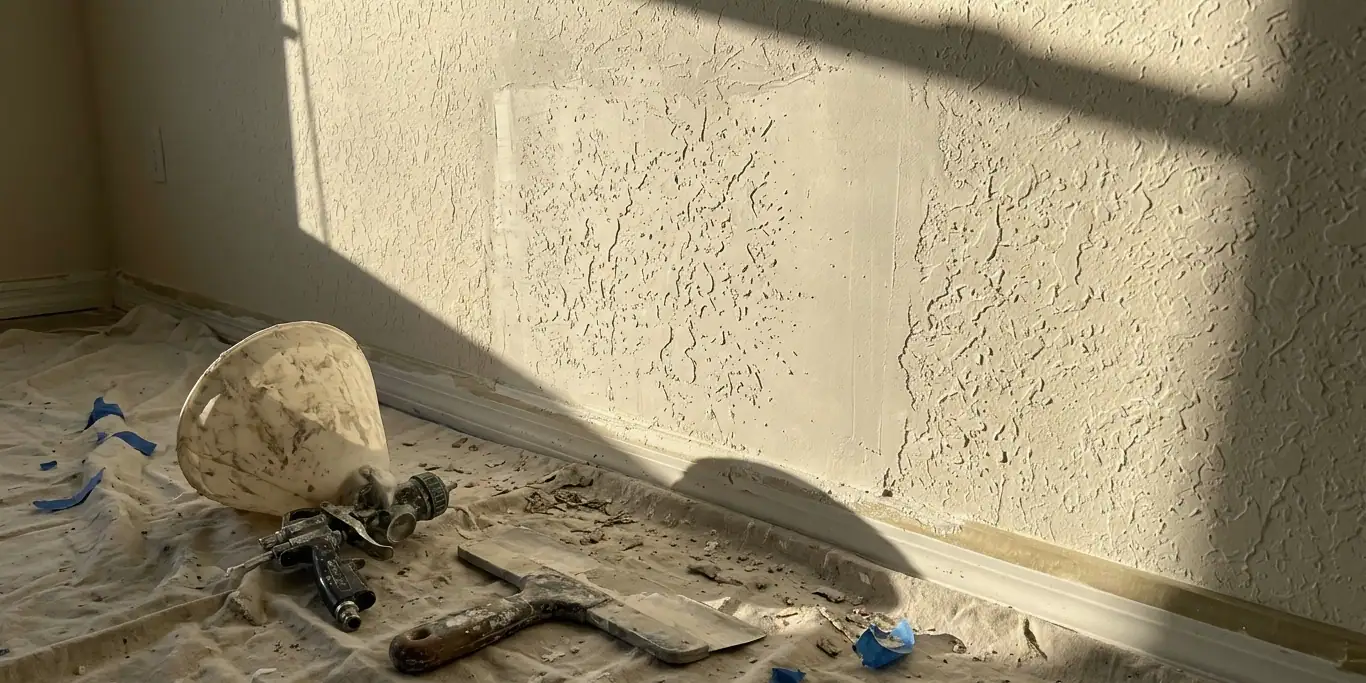
Textures common in Wesley Chapel homes
Most homes built here since the 1990s have one of a few textures. Knockdown is the most common, a sprayed splatter flattened with a wide knife, leaving flat islands. Orange peel is a finer spray left to dry as it lands, with a dimpled look like the skin of the fruit. Some custom homes have hand-troweled textures like skip trowel or Santa Fe. Newer homes increasingly have smooth Level 5 walls. Ceilings are often knockdown or orange peel, and older homes may still have popcorn.
- Knockdown: flat-topped islands, density and spread vary by house
- Orange peel: fine, even dimples, light to heavy
- Skip trowel: hand-troweled patches with smooth gaps between
- Smooth: no texture, which demands a perfect surface
Why matching is harder than it looks
Two knockdown walls can look nothing alike. The size of the spatter, the thickness of the mix, the air pressure, how long it sits before being knocked down and how hard the knife presses all change the result. The original installer had their own habits, and they were spraying fresh board. We are matching aged texture that has been painted two or three times, which softens the peaks.
So we never go straight to the wall. We mix and spray samples on scrap board, compare under the light in your room and adjust the mix and timing until the sample reads like the wall around the repair.
Blending the edges
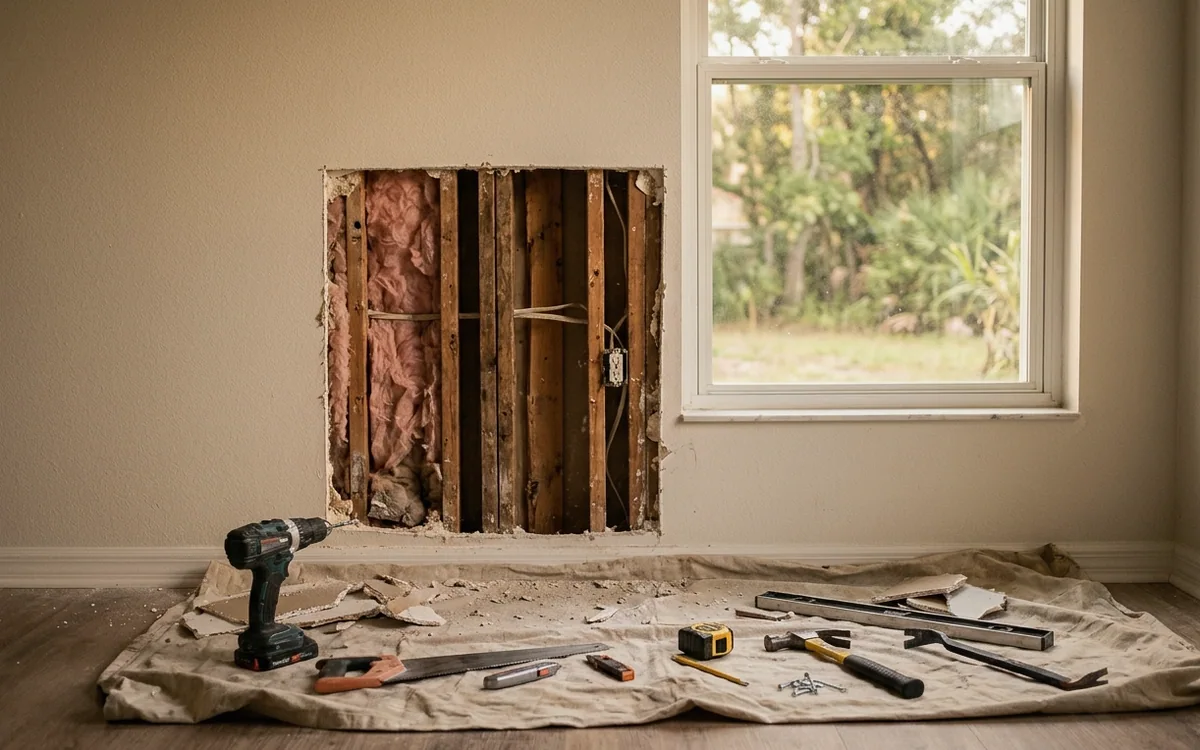
A texture match fails at the edges more often than in the middle. We feather the new texture past the patch onto the old surface, lighter as it goes out, so there is no ring around the repair. Then we look at it in raking light, a work light held flat against the wall, which shows flaws that overhead lights hide.
Ceilings take extra care because ceiling lights and window light hit them at a low angle. If the patch is large or the ceiling has been painted many times, we sometimes recommend retexturing a full section from wall to wall. After a popcorn removal, many owners have the whole ceiling refinished in knockdown or smooth.
Changing a texture on purpose
Some homeowners want to change the texture entirely, usually going from heavy knockdown to smooth for a more modern look. That means skim coating the whole wall or ceiling, sanding and priming, which is a bigger job than a match but transforms the room. We can do one room as a test so you see the result before committing to more.
Call us when you notice
- A patch is smooth while the wall around it is textured.
- Someone sprayed can texture and it looks like dots.
- A new wall does not match the old ones beside it.
- A ceiling repair shows a ring under the lights.
- You want heavy knockdown changed to smooth walls.
How a wall & ceiling texture matching job runs
Identify the texture
We look at the wall in raking light and note texture type, size, density and paint layers.
Sample on scrap
We spray or trowel samples on scrap drywall and compare them to your wall in the room's light.
Prepare the area
The repair is primed so texture does not absorb unevenly, and floors and furniture are covered.
Apply and feather
Texture goes on the repair and fades into the surrounding surface so there is no edge.
Prime and paint
Once dry, the area is primed and the wall or ceiling painted edge to edge.