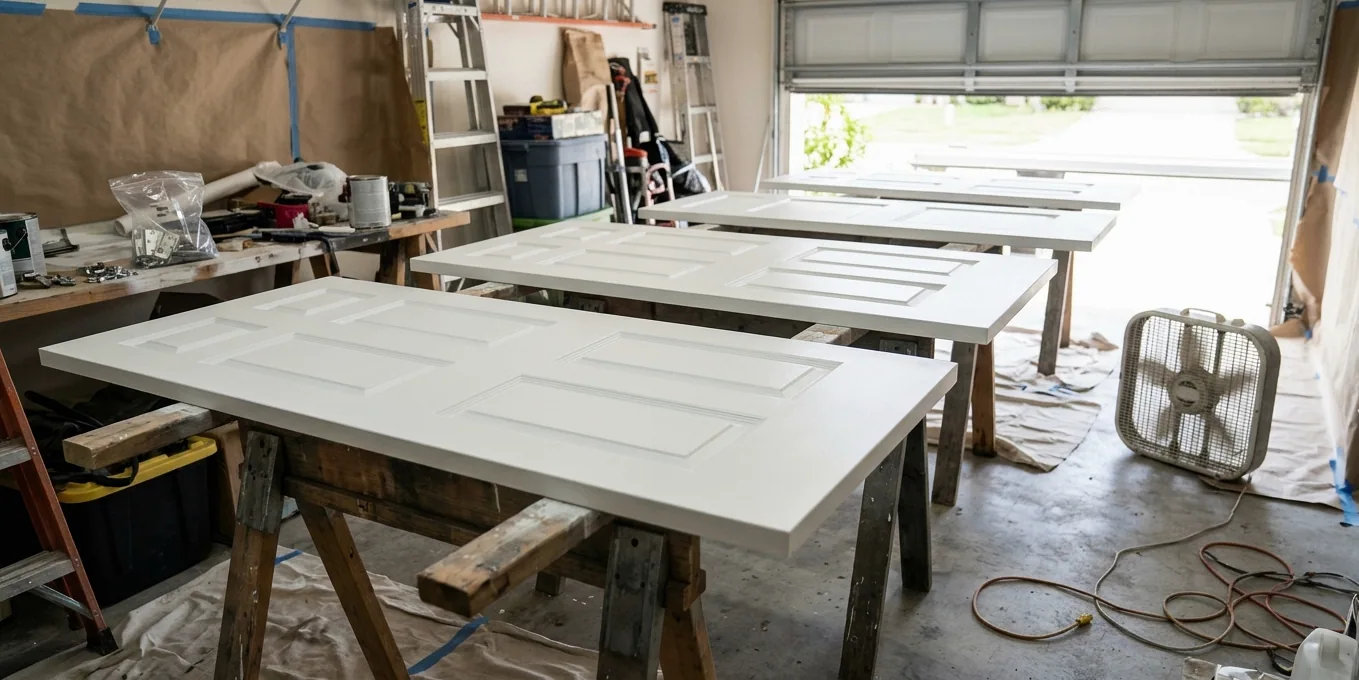
Hollow-core, solid-core and bifolds
The molded six-panel and two-panel shaker doors in most homes here are hollow-core with a hardboard skin. The skin takes paint well, but the panel grooves collect drips when brushed, which is why we prefer to spray. Solid-core doors, often added in upgraded homes or primary suites, are heavier and get the same process on stronger sawhorses.
Closet bifolds and pantry doors with louvers take the longest. Each slat has two faces and an edge, and a brush cannot get into them cleanly. Spraying is the only way to get even coverage without runs.
Top and bottom edges
Builders rarely paint the top and bottom edges of a door. In a humid house, those raw edges soak up moisture, the door swells, and it starts rubbing the jamb or the carpet transition. We seal all six sides while the door is off. If a door already sticks, we plane the edge where it rubs, then seal it.
Pocket doors are trickier, since they cannot come off easily without opening the wall. We mask the opening and paint them in place with a short-nap roller and a brush on the edges.
Dark doors and contrast
Black, charcoal and deep green interior doors have become a common request, especially against white trim. Dark colors show every brush mark, so spraying matters even more. They also need an extra coat and a little longer between coats so the color goes on full and even. If you are changing the trim at the same time, we schedule it with our trim and baseboard painting so both finishes are matched.
Hardware and hinges
Paint on a hinge is a sign of a rushed job. We handle hardware like this:
- Hinges are removed with the door and kept in labeled bags, never painted over.
- Knobs and lever sets come off and are cleaned before going back on.
- If you are swapping brushed nickel for matte black, we install the new set.
- Stripped hinge screw holes get a longer screw so the door hangs true.
Call us when you notice
- Doors look yellowed or dingy next to fresh walls
- Scuffs and handprints around the knob that will not wash off
- A door rubs the jamb in summer and closes fine in winter
- Old brush marks and drips in the panel grooves
- You want black or colored doors against white trim
How a interior door painting job runs
Count and tag
We number every door, its hinges and its opening so each one goes back where it came from.
Pull doors and hardware
Doors come off and go to a masked spray area, usually the garage.
Sand, fill and prime
Dents and dings are filled, the surface is scuffed, and bare edges are primed.
Spray two coats
Both faces and all edges are sprayed, with drying time between coats.
Rehang and check swing
Doors go back on their hinges and we check that each one latches and clears the floor.