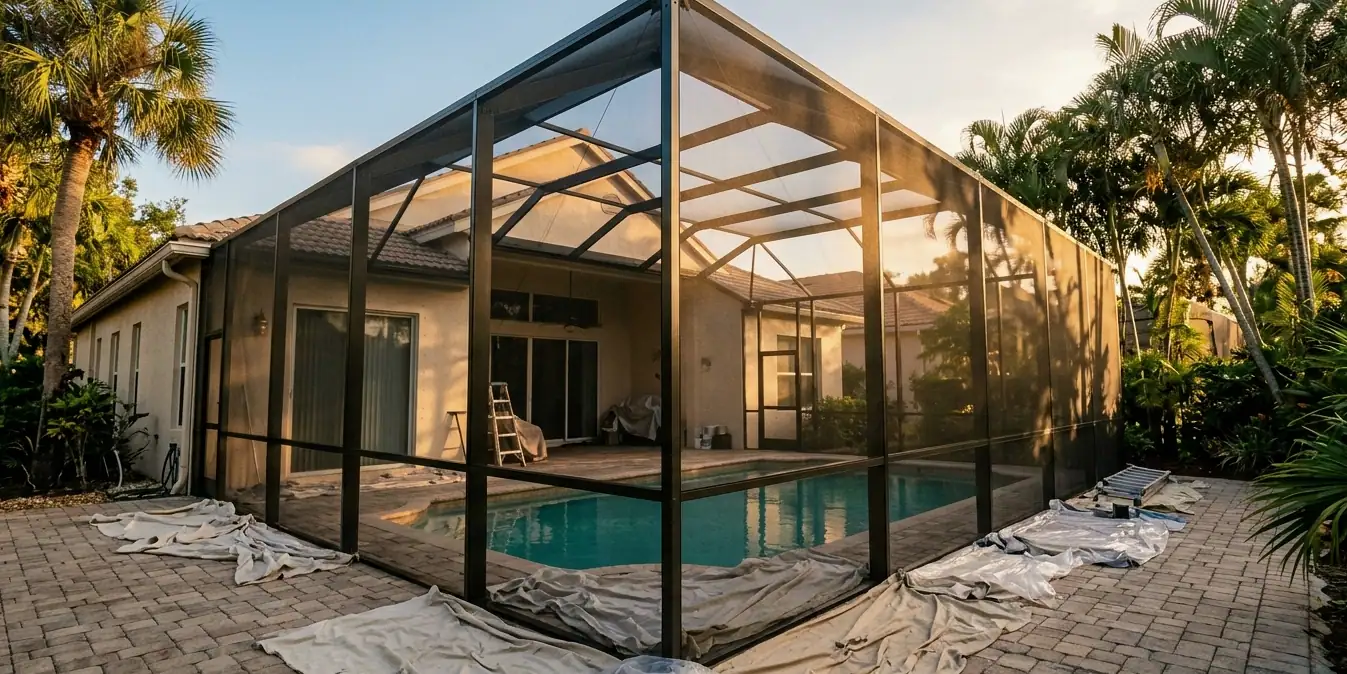
What happens to an aluminum cage
Pool cages are built from extruded aluminum with a factory powder coat, usually white or bronze. In full Florida sun and pool chemistry, that coating oxidizes. You will notice a chalky film that comes off on your hand, spotty fading on the top beams, and white streaks running down the uprights after rain. On older white cages, the finish can look gray and dirty even after washing.
The aluminum underneath is almost always still sound. The frame does not need replacing, just a new coating.
Hardware is the exception. Stainless or zinc screws and the kick plates along the bottom rail can rust and stain the frame. We replace corroded fasteners we find during prep so rust streaks do not bleed through the new coat.
Painting around the screens
This is the part that sets cage painting apart from regular painting. Spraying a cage overspray-free means masking or bagging screen panels near the work, using a low-pressure sprayer, and back-brushing every beam. We paint from the top down so drips fall onto uncoated surfaces, and the pool itself gets covered so nothing settles on the water.
If your screens are already torn, faded or full of holes, the best time to replace them is right after painting, when the frame is clean. Our pool cage rescreening crew follows the paint crew so it all comes together.
Coatings that stick to aluminum
Regular house paint peels off aluminum. The process we use:
- Wash with a cleaner that removes chalk and pool chemical residue.
- Scuff the frame and wipe it down so the primer can grip.
- Apply a bonding primer formulated for nonferrous metal.
- Finish with two coats of a UV-resistant acrylic or urethane made for aluminum.
Lanai ceilings and walls
Under the roof section of most lanais is a painted ceiling, usually stucco, aluminum panels or tongue and groove. It catches moisture from the pool and grows mildew in the corners. We clean, prime with a mildew-resistant primer, and paint it while we are set up. The back wall of the house inside the cage often gets repainted in the same visit, and the pool deck can be refreshed too with a pool deck coating.
Call us when you notice
- Chalk on your hand when you touch a beam
- White streaks running down bronze uprights after rain
- Gray, dull color on an older white cage
- Mildew in the corners of the lanai ceiling
- You are rescreening and want the frame refreshed too
How a pool cage & lanai painting job runs
Inspect the frame
We look for loose fasteners, bent beams and screen damage before quoting.
Clean and scuff
The frame is washed of chalk and chemicals, then scuffed and wiped down.
Mask the screens and pool
Screens near the work, the pool, and the deck are covered or bagged.
Prime and paint
Bonding primer goes on, then two coats of aluminum coating, sprayed and back-brushed.
Remove masking and clean up
Coverings come off, the deck is rinsed, and we walk the cage with you.