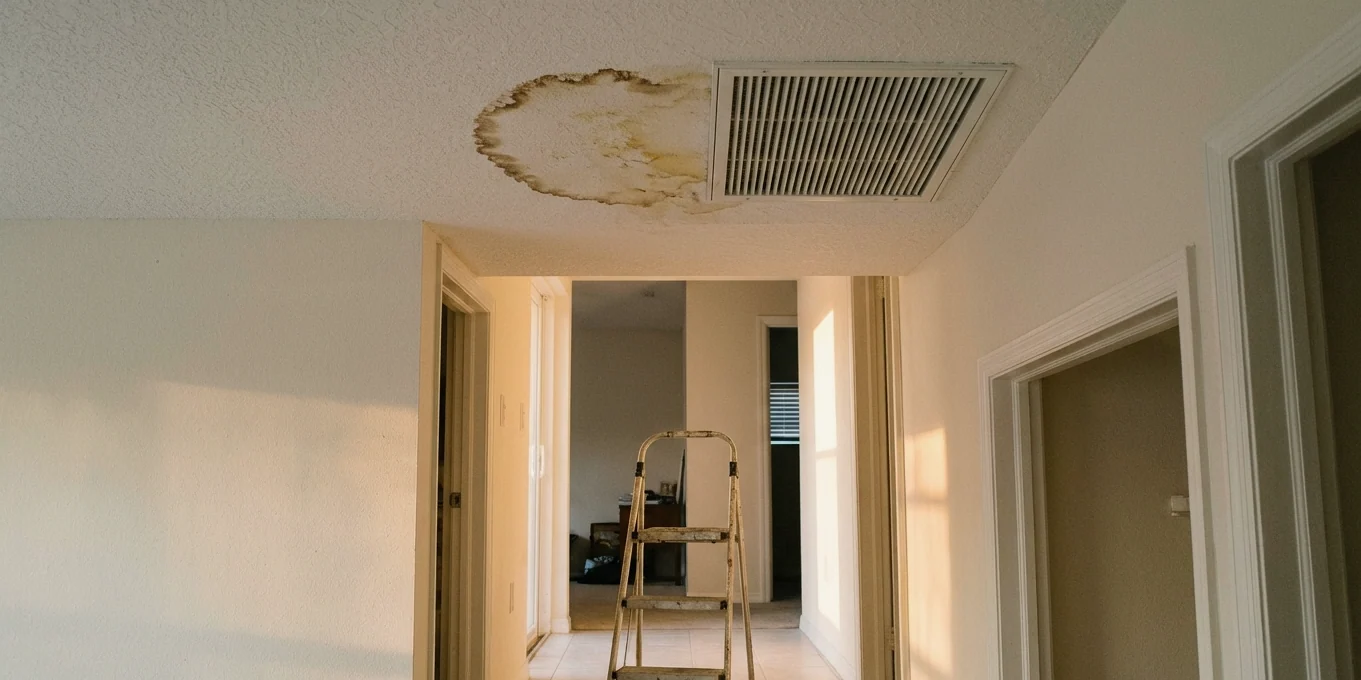
Find the source first
A ceiling stain is a symptom. Before anyone talks about primer or paint, you need to know where the water came from and whether it has stopped. Painting over an active leak gives you a fresh white ceiling for a few weeks, followed by the same stain, plus wet insulation and possible mold above it.
Look at where the stain sits. Is it near a bathroom, under the air handler closet, near an outside wall, or in the middle of a room? Has it grown after a rain, or after the AC has been running hard? Did it show up after a storm? Those clues point you to the cause.
AC leaks are very common in Florida homes
In Pasco County, many ceiling stains come from the air conditioning, not the roof. Your AC pulls a lot of water out of humid air, and that water has to drain away through a condensate line. When something in that path fails, water ends up on the ceiling.
- Clogged condensate drain line. Algae and sludge build up inside the PVC line, water backs up, and the pan overflows. This is the most common cause in summer.
- Attic air handler. In homes where the air handler sits in the attic, an overflowing pan or rusted pan drips straight onto the ceiling drywall.
- Sweating ducts. Poorly sealed or uninsulated ducts in a hot attic can drip condensation onto the ceiling below.
- Disconnected or cracked line where the drain leaves the unit or passes through the attic.
- Failed float switch that should shut the unit off when the pan fills.

Roof and other causes
Roof leaks usually show up after rain, and the stain often sits near an outside wall, a plumbing vent, or below a valley or skylight. On concrete tile roofs, a cracked tile or worn underlayment may let water through. On shingle roofs, missing shingles after a storm or failing flashing around vents are common. Call a roofer for anything on the roof itself.
Plumbing is the other suspect. A stain below a second-floor bathroom, especially one that grows when someone showers, often points to a leaking drain, wax ring or supply line. Note when you see the stain change so a plumber can narrow it down.
Once the leak is fixed, check the drywall
After the source is repaired, let the area dry. Running the AC and a fan for several days helps. Then press gently on the stained area. Firm and dry drywall can usually be primed and painted. If it is soft, sagging, crumbles at the touch or has a bubble of paint holding water, it needs to be cut out.
Drywall should be removed and replaced when:
- The panel sags or feels soft or spongy.
- Seams have opened up or tape has lifted.
- There is a musty smell or visible mold growth.
- The insulation above was soaked and stayed wet for days.
- The stain covers a large area and the leak ran for a long time.
Why stain-blocking primer matters
Water leaves behind minerals and tannins that bleed through ordinary paint, even several coats of it. That is why a brown ring shows up again after you paint over it with ceiling white. The fix is a stain-blocking primer, usually an oil-based or shellac-based product, applied over the stain and a little beyond it before the finish coat.
After the primer dries, the whole ceiling plane is usually repainted, not just the spot. Ceiling paint ages and yellows, and a patch of fresh white in the middle of an older ceiling will stand out. If your ceiling has a knockdown or orange peel texture, a patched area must be retextured to match so it blends.
What repair costs
Priming and repainting a stained ceiling in one room typically runs about $265 to $540. Cutting out and replacing a section of wet drywall, taping, texture matching and repainting usually lands around $485 to $1,170 for a small to medium area. Our water-damaged drywall repair covers the cut-out, patch, texture and paint in one visit when possible, and texture matching blends the repair into the rest of the ceiling. The final price follows a free on-site look.
Call (813) 471-5995 once the leak is fixed. If you are not sure whether it is fixed, we will tell you what we see and whether the area is dry enough to work on.