
What each coating actually is
Standard exterior acrylic paint, often labeled 100% acrylic latex, is what goes on most Florida homes. It forms a film a few thousandths of an inch thick, breathes reasonably well, and comes in every sheen and color.
Elastomeric wall coating is also acrylic based, but it is built to stretch. It goes on much thicker, often five to ten times the dry film thickness of regular paint, and it can stretch well beyond its original size and recover. That flexibility lets it bridge hairline cracks in stucco and keep wind-driven rain out.
Both are water based, both clean up with water, and both come from the same paint aisle. The difference is in how much film ends up on the wall and how that film behaves when the stucco moves. On a typical Wesley Chapel block home, the stucco expands in the afternoon sun and contracts when a storm cools it off, sometimes in the same hour. Regular paint handles that movement over smooth stucco. Over open cracks, it splits along the crack line within a few seasons.
Where elastomeric makes sense
Elastomeric earns its price on homes with a lot of hairline cracking, map cracking, or walls that take a beating from sideways rain. It is popular on west and south walls in Pasco County that see the most sun and storm exposure. Some homeowners use it on the whole house, others only on the problem sides.
It also helps on older stucco that has been painted several times and has lost some of its own water resistance. A good elastomeric job gives you a thick, rubbery skin that sheds water. On houses near open fields or retention ponds, where wind drives rain straight at the walls, that extra film makes a visible difference after a couple of rainy seasons.
- Many hairline cracks across the walls.
- Walls that take direct wind-driven rain during summer storms.
- Older stucco where previous paint has worn thin.
- Homeowners who plan to stay put and want a longer repaint cycle.
Where regular acrylic is the better pick
A good 100% acrylic is the right choice for many Wesley Chapel homes, especially newer houses with tight stucco and only a few cracks. It costs less, goes on faster, and is easier to touch up or repaint later. It also allows more water vapor to pass through, which matters on walls that already have moisture inside them.
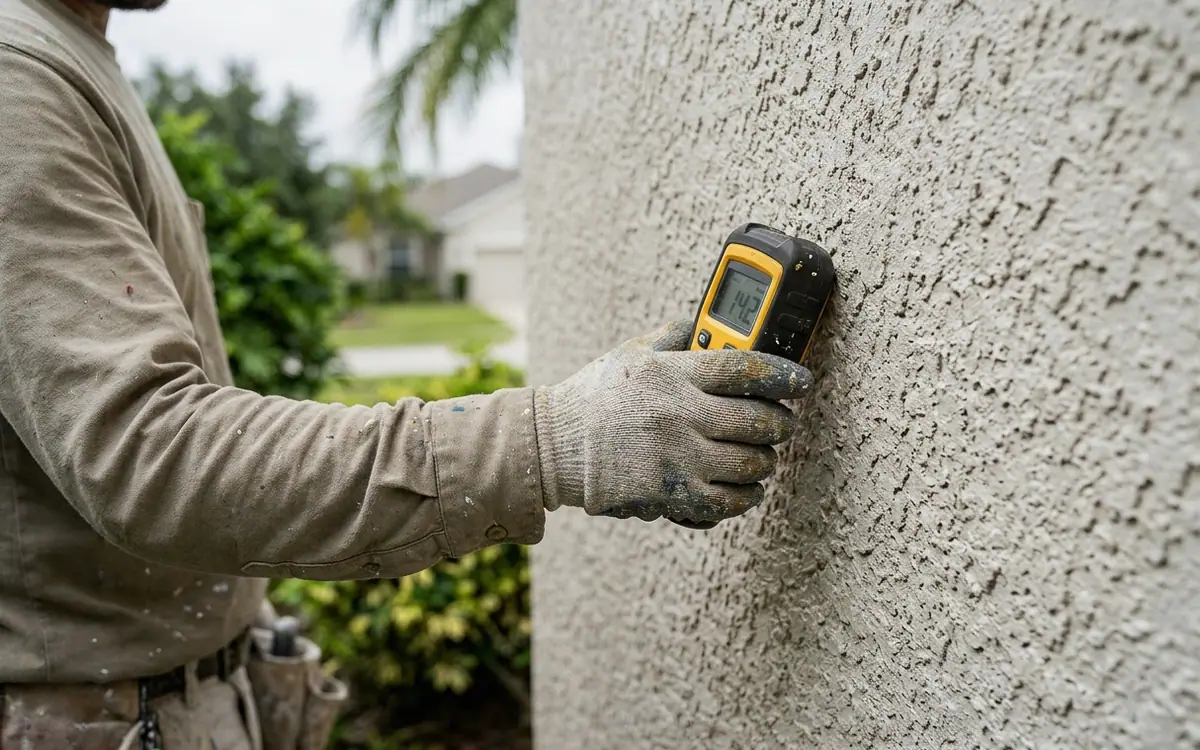
That breathability point is important. Elastomeric slows vapor movement. If water is already getting into the wall from a leaking window, a bad roof flashing or a cracked sill, an elastomeric coat can trap it, and you may see blisters filled with water later. Fix the leaks first, then choose the coating.
Cost and coverage compared
Elastomeric uses much more material. A gallon of acrylic might cover 250 to 400 square feet of stucco per coat, while elastomeric often covers only about 80 to 120 square feet at the thickness that gives it crack-bridging power. Labor goes up too, since it is heavier to roll and needs careful attention to thickness.
For a typical single-story stucco home in our area, a standard two-coat acrylic repaint runs about $3,860 to $6,940. A full elastomeric wall coating job on the same house often lands around $5,780 to $9,460. Coating only the two sunniest walls in elastomeric and the rest in acrylic falls in between. The final price follows a free on-site look.
Things to know before you choose elastomeric
A few practical points that are easy to miss:
- It is hard to go back. Once a house has elastomeric, regular paint over it can crack or peel unless the right primer is used, so plan on staying with it.
- It shows texture differently. The thick film fills in some of the stucco texture and can look slightly softer.
- Color choices can be narrower, and very dark colors are not always offered.
- Surface prep is stricter. Chalk, dirt and mildew must be fully removed, and the wall must be completely dry.
- It is not a fix for structural cracks. Wide or offset cracks need stucco repair first.
How a painter should help you decide
A good estimate starts with a walk around the house. The painter should check how many cracks you have and how wide they are, look for signs of trapped moisture such as bubbles or stained trim inside, and ask how long you plan to stay. If the answer for your house is plain acrylic with crack filling, that is a fine answer.
Call (813) 471-5995 and we will look at your stucco with you, side by side, and give you a written estimate for both options if both make sense. You will know exactly what you are paying for and why.