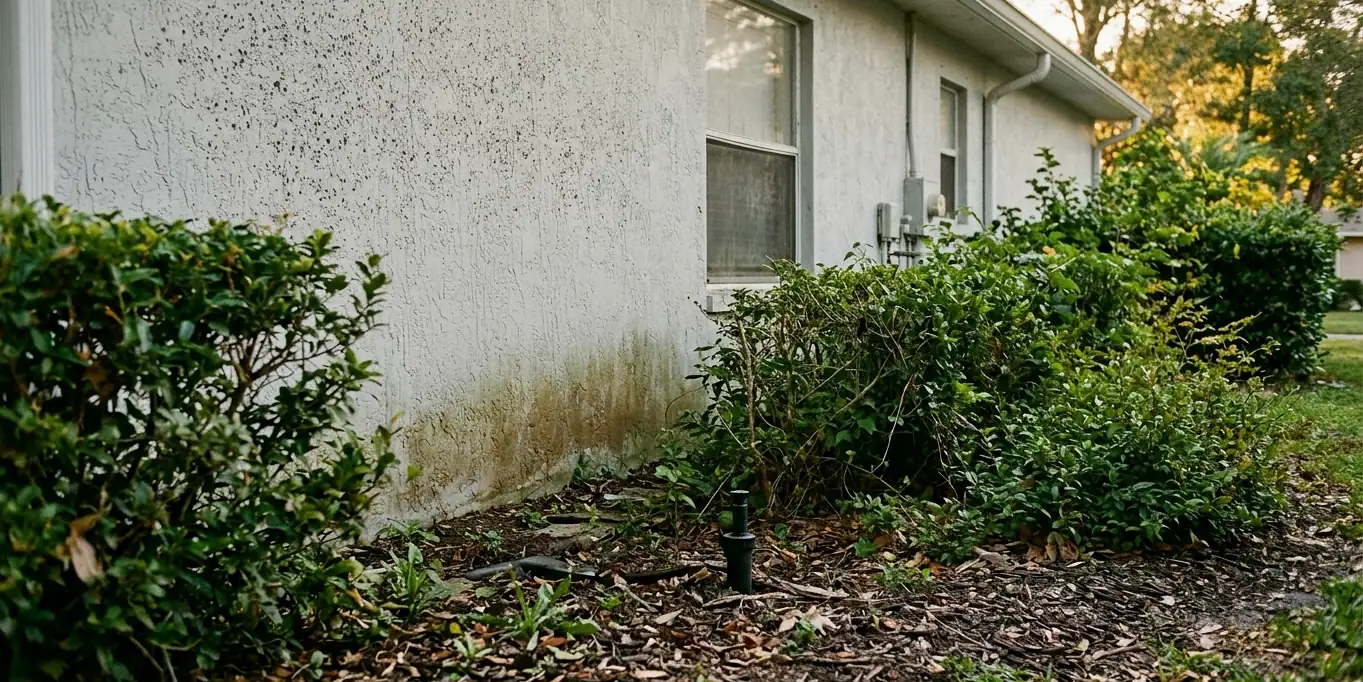
Why mildew loves Florida walls
Mildew is a mold that feeds on dirt, pollen and organic material that settles on paint. Green and black algae often grow alongside it. All of them need moisture and shade, and Tampa Bay delivers plenty of both. High humidity, morning dew, summer rain and sprinklers keep walls damp for hours every day.
Stucco makes it easier. Its rough texture holds dust and water, and older paint that has gone chalky gives mildew even more to grip. Once it gets going, it spreads across the whole shaded area within a season.
Where it shows up first
Mildew follows shade and water. On most Wesley Chapel homes, you will spot it first in these places:
- North-facing walls, which almost never get direct sun.
- Behind dense shrubs and hedges planted close to the house.
- Under soffits and eaves, especially near bathroom vents.
- Low on walls where sprinklers hit every morning.
- Next to downspouts and wherever roof runoff splashes.
- Along the inside of lanai walls and ceilings with little air movement.
- On walls facing a retention pond, wooded preserve or conservation area.
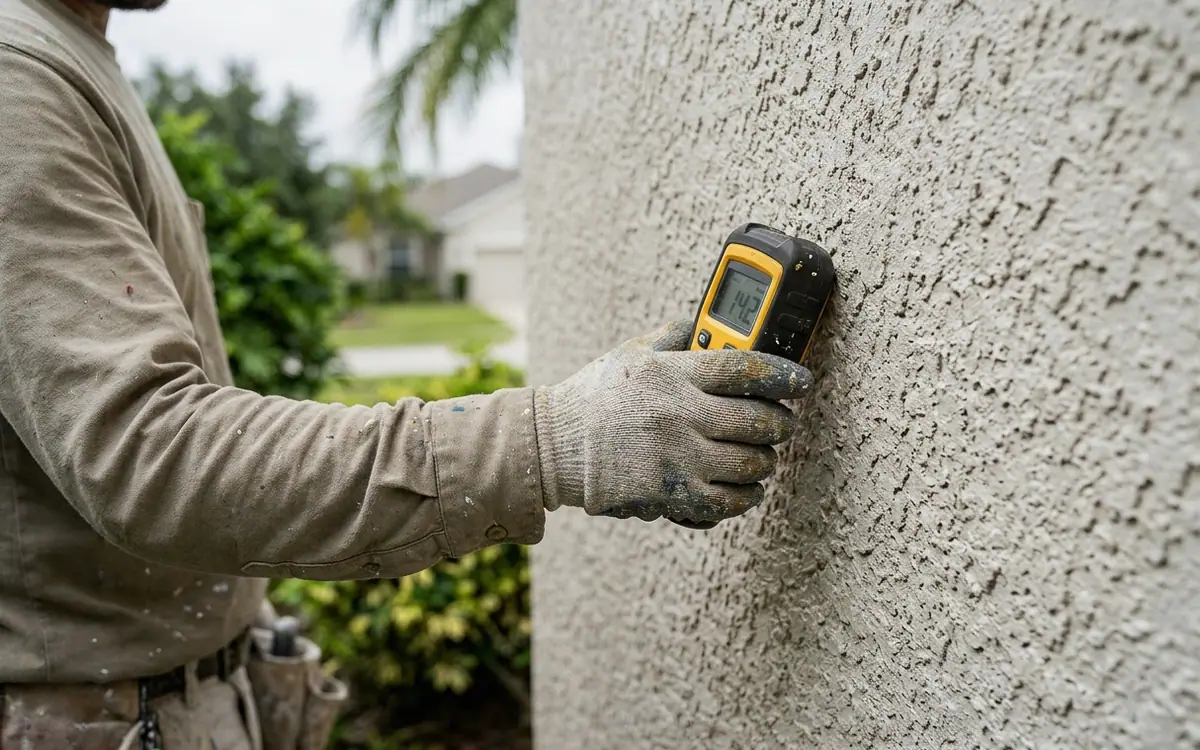
Is it mildew or dirt?
Here is a simple test. Put a few drops of household bleach on a dark spot. If it lightens within a minute or two, it is mildew or algae. If it stays the same, it is dirt or something else. Do this on a small area and rinse it off with water afterward.
Dirt and mildew often appear together, which is why washing usually tackles both.
Look at the pattern as well. Mildew tends to spread in speckles or patches that start in corners and shaded spots. Dirt usually shows as streaks below window sills, light fixtures and roof edges, where rain carries it down. Red or orange stains low on the wall are often from well water in the sprinklers, which is iron, not mildew, and needs a different cleaner.
How to clean it safely
The safest approach for stucco is a soft wash rather than blasting with high pressure. A diluted cleaning solution containing sodium hypochlorite, the active ingredient in bleach, is applied at low pressure, left to work for several minutes, and rinsed off. High pressure can force water into stucco cracks and etch the surface, so it is not the right tool for most walls.
Protect your plants by watering them before and after, and rinsing any overspray off leaves. Cover outlets and light fixtures, keep the solution off your car, and never mix bleach with ammonia or other cleaners. If you have a second story, a professional crew is the safer option than standing on a ladder with a sprayer. Our pressure washing crews use soft wash on stucco and save higher pressure for concrete and pavers.
Why painting over mildew fails
This is the most common mistake we see. Mildew is alive. Paint it over and it keeps growing under the new film, feeding on the dirt still there and the paint itself. Within months it bleeds through as gray or black spots, and the new paint can lose adhesion and peel because it is stuck to a layer of growth instead of the wall.
Even mildew-resistant paint cannot kill what is already on the wall. The additives in those paints help prevent new growth, but the wall still has to be clean, rinsed and fully dry before any paint goes on. If a painter suggests skipping the wash to save time, that is a red flag.
Keeping it from coming back
You cannot stop mildew completely in Florida, but you can slow it down a lot:
- Trim shrubs back at least 18 inches from the wall so air can move.
- Adjust sprinkler heads so they do not spray the stucco.
- Clean gutters and add downspout extensions so water lands away from the house.
- Choose a paint with a mildewcide additive when you repaint, especially on north walls.
- Wash the house every 12 to 24 months, before growth gets thick.
- Think about a lighter color on walls that stay in shade; dark colors can hold moisture longer.
Cost of cleaning versus repainting
A soft wash of a single-story stucco home in our area usually runs about $285 to $545, and two-story homes land higher. If the paint underneath is chalky or peeling once it is clean, an exterior repaint with a mildew-resistant finish is the next step. The final price follows a free on-site look. Call (813) 471-5995 and we will tell you whether a wash is enough or the paint has reached the end of its life.